Charlie Cavendish
The IPCRESS FileCharlie Cavendish is an undercover man for C-SICH, a witty and book-loving Londoner, and one of Unnamed narrator’s most trusted friends. Their bond began with Reg Cavendish, Charlie’s son and Unnamed narrator’s close wartime companion. Charlie’s murder turns that personal history into a point of collision between intelligence organizations: he is killed because he is mistaken for Unnamed narrator, and his connection to C-SICH makes the consequences larger than the immediate crime.
Identity and Background
Charlie works undercover for C-SICH. His position is not a senior one; his devastating sense of humour, which could illuminate dark situations, also kept him from rising high in the organization. In civilian life he is associated with Bloomsbury, where his small flat is near the British Museum, and he supplements his work with a part-time job as a barman at the Tin-Tack Club.
His home reflects the life he has chosen. Unnamed narrator estimates that the flat holds about three thousand books, filling its rooms so densely that little wall remains visible. Charlie’s devotion to books is presented as more than decoration: it helps explain why he has not progressed beyond the 1947 Hillman he drives. The old car, modest apartment, and crowded shelves give a concrete shape to a man whose priorities differ from the status and material rewards available in intelligence work.
Charlie’s humour makes him memorable without making him frivolous. He can meet Unnamed narrator’s trouble with a joke, but he also recognizes when help is needed and acts on that recognition. His warmth and practical care are central to the trust between them.
Reg Cavendish and Unnamed narrator
Charlie’s friendship with Unnamed narrator is rooted in the latter’s friendship with Reg. The two young men had been inseparable: Reg was quiet, while Unnamed narrator was vociferous, and their temperaments fitted together. Reg was a tall, gangling boy with ginger hair, a bright pupil, and a particular gentleness. He was also deeply knowledgeable about the countryside, from weather patterns and birds to animals and wild flowers.
In the army, Reg’s quiet competence became a form of leadership. He went to the hardest and most dangerous places first and used force economically. During the Tunisian campaign, when the parachute brigade served as infantry, he became one of the youngest regimental sergeant majors in the British Army and acquired the nickname Springer. His photograph, wearing a boat-shaped forage cap, remains on top of Charlie’s writing cabinet.
Reg survived four years of combat action but was killed by a truck in Brussels four days before VE Day. Unnamed narrator was the person who brought Charlie the news, reporting the traffic accident as simply as he had heard it. Charlie went to make coffee, and the two men spoke about ordinary subjects, including the weather and the wartime Cup Final. That conversation shows their shared way of approaching grief: they could remain together without forcing the loss into words. The photograph’s survival among the wreckage of Charlie’s flat later gives Reg’s memory a quiet, physical presence in the account of his father’s death.
Friendship and Practical Care
Charlie’s relationship with Unnamed narrator continues beyond the original connection through Reg. He recognizes Unnamed narrator’s voice when he calls on a reversed-charge line and accepts the call. Unnamed narrator identifies himself as a friend of Reg and admits that he is in serious trouble. The call leads to Charlie taking him in rather than leaving him to manage alone.
When they meet, Charlie sees the marks on Unnamed narrator’s face and responds with gentle humour. Although Unnamed narrator has been to a Turkish bath, he remains weak; Charlie insists that he come back to his flat and helps him into the 1947 Hillman. Unnamed narrator wakes the next morning in Charlie’s bed, while Charlie has spent the night on the sofa. Food, rest, and shelter are practical expressions of an attachment that is neither casual nor confined to their old connection through Reg.
The familiarity between them includes recurring private jokes. Unnamed narrator has previously called Charlie Uncle Charlie, and Charlie has recited stanzas from Paradise Lost in the steam room on earlier occasions. Their banter gives the friendship a lived history, while Charlie’s care during Unnamed narrator’s crisis shows what lies beneath it. When Unnamed narrator later returns to the flat, he intends to give Charlie his key and speak to him before Charlie leaves for his shift at the Tin-Tack Club.
The Coded Message and Murder
Before the murder, Charlie sends a civilian cable from Gerrard Street post office in London. It is paid for in cash and signed Artemidorus. Its wording, about reading a paper in JC on the third of the second, is an indirect message rather than an ordinary personal note. Unnamed narrator recognizes the sender as Charlie and finds the cable especially sobering. Its coded form places their friendship inside the habits of intelligence work: even a warning between friends must travel through concealment.
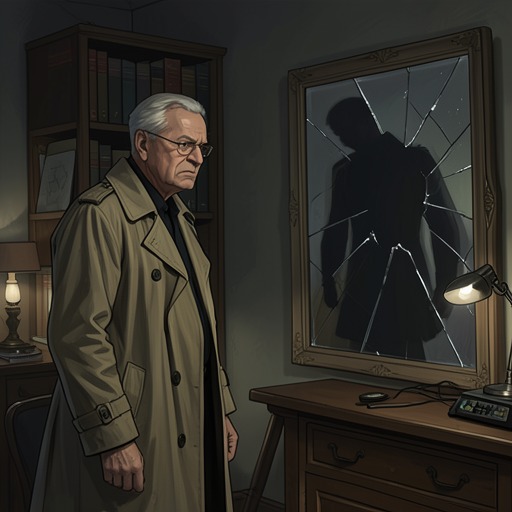
When Unnamed narrator returns to Charlie’s flat, he hears a woman sobbing and proceeds upstairs rather than turning back. The rooms have been ransacked. Charlie is dead on the landing; books have been thrown from the shelves, and the coffee pot is broken. Records, letters, flowers, ornaments, and a small carriage clock have been swept from the writing cabinet, but Reg’s photograph is the one object left in place. A young woman is present in the flat. Unnamed narrator leaves, aware that the police will be looking for him as well as whoever killed Charlie.
The danger to Unnamed narrator soon becomes public. A radio news report says that police want to interview a man seen near the crime scene and gives a description of him. When Unnamed narrator asks Jay who killed Charlie, Jay answers that responsibility belongs to all of them: Unnamed narrator, Jay, and Jay’s people. The answer broadens the murder from an isolated attack into a consequence of the conflict surrounding them.
Mistaken Identity and Narrative Role
The circumstances later become clear. Charlie had lent Unnamed narrator several items of clothing, including a light-blue raincoat. Unnamed narrator returned it to Charlie at Fortes; Charlie wore it when he left and went home. The attack was intended for Unnamed narrator, but the raincoat led to a fatal case of mistaken identity. A hoodlum working for Jay’s network carried it out.
The account distinguishes the attacker’s responsibility from Jay’s own response. Jay was not described as having ordered Charlie’s death. On learning that Charlie was connected with C-SICH, he hurried to speak with Dalby, hoping to contain the consequences. Dalby could not make the matter disappear, because C-SICH had direct connections through industry as well as its combined-services side. Charlie’s position therefore gives the murder institutional weight: the attack puts Jay’s network, Dalby, and C-SICH into a crisis that cannot be settled privately.
Charlie’s narrative importance rests on the collision between a specific friendship and an impersonal trade in identities, surveillance, and retaliation. His loyalty is shown through coded communication and hospitality; his death follows from a garment passed between friends. The light-blue raincoat, meant as an ordinary loan, becomes the mechanism by which the attack misses its intended target only in name. Reg’s photograph, left untouched amid the wreckage, connects the loss of father and son across the two defining tragedies in Charlie’s life.